

Is the Stamets Stack all that?
Why the famous microdosing protocol misses crucial ingredients

In the universe of microdosing, the “Stamets Stack” is a bonafide rockstar. Popularized by world-renowned mycologist Paul Stamets, this combination of psilocybin, Lion’s Mane mushroom, and niacin (Vitamin B3) is touted for its effectiveness but is it really effective? Is it the end-all, be-all to microdosing?
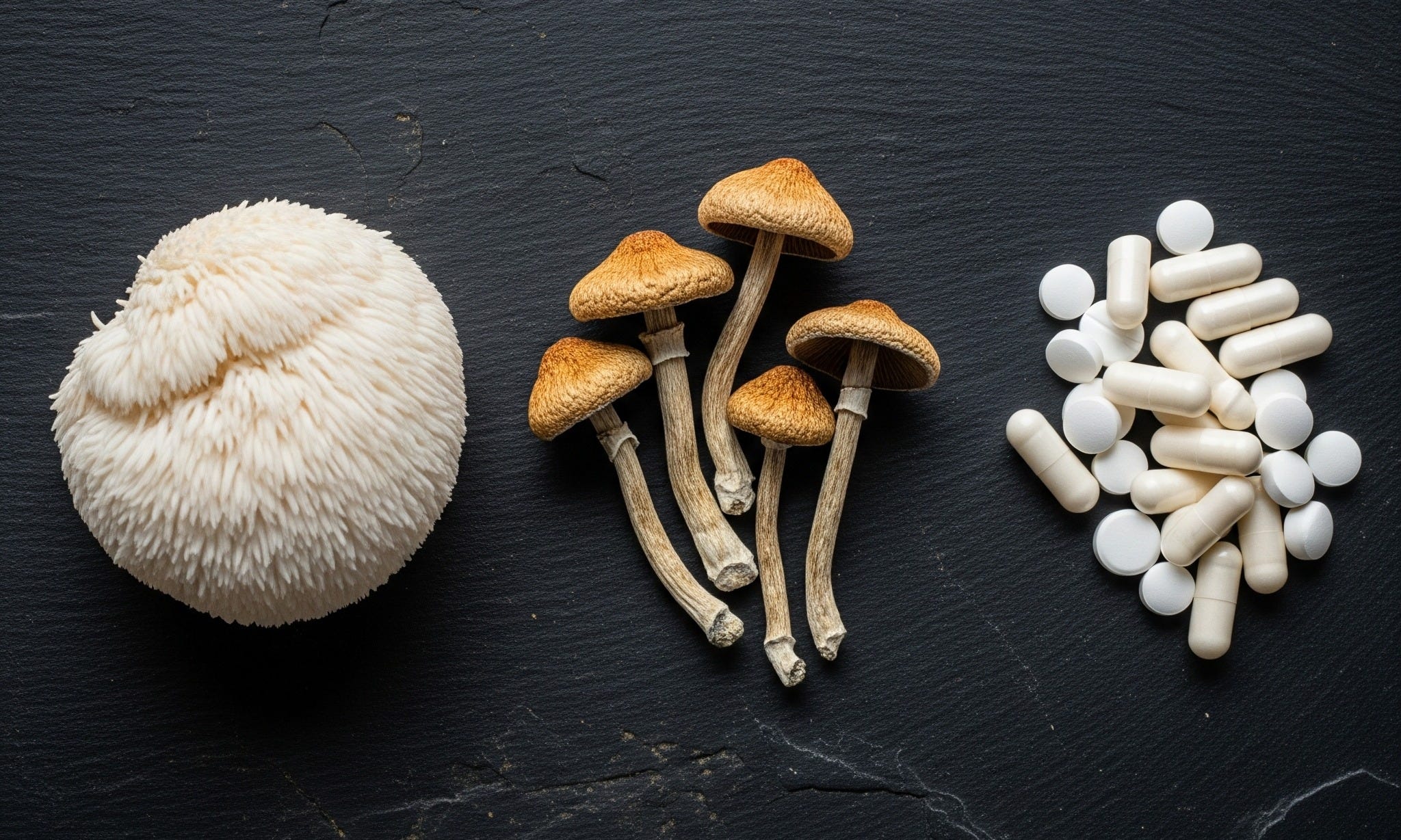
Let me be clear about my position on the Stamets Stack: I’m not a fan. My issue isn’t with the stack itself, but with how it gets hyped up for the wrong reasons while overlooking what's most important.
Niacin
The most debated component of the stack is niacin. Niacin, also known as Vitamin B3, is known for the “niacin flush,” the reddening, tingling, and warming of the skin. The reason it was included in the stack is supposedly the vasodilation (the widening of blood vessels) that occurs helps deliver psilocybin and Lion’s Mane to the far reaches of your peripheral nervous system.
However, the science doesn’t quite match this assertion. The flush is primarily a temporary, skin-level histamine response that lasts 30-90 minutes. There is little evidence to suggest this surface-level event meaningfully alters how molecules cross the highly-regulated blood-brain barrier to affect your brain.
The Good
Most people are very disconnected from their body (aka all up in their head) and have bad interoception (awareness of what is happening inside themselves). The flush is a form of forced interoception. The physical sensations of the flush make the body difficult to ignore. It forces a moment of bodily awareness.
Niacin is an essential nutrient so like nearly every other essential nutrient, you can find Niacin easily sold as a supplement. There is some evidence that supplementing with Niacin can help with a myriad of things such as cholesterol management, blood pressure, and skin health.
The Not-So-Good
There is a conception that in order for something to be working, you must feel it. This is contrary to the “less is more” understanding of how microdosing actually works.
In addition, for a nervous system already dysregulated or stuck in a state of high alert (a "Sympathetic" state of fight-or-flight), this sudden, uncomfortable experience can easily be perceived as a threat. Instead of a helpful tool, it becomes another stressor, potentially increasing anxiety and dysregulation.
Then there are the side effects of taking too much niacin:
Liver damage
Gastrointestinal issues
Worsening diabetes or gout
Increased risk of heart disease
General recommendations suggest getting Niacin from nutrition through foods like meat, fish, poultry, and legumes.
Psilocybin
The Stamets Stack is almost always discussed in the context of a daytime schedule, 4-5 days a week for the intended purpose to boost creativity, focus, and well-being. This framing overlooks a fundamental truth about this medicine: psilocybin is deeply emotional.
Research consistently shows that psilocybin’s primary action is modulating activity in the brain's core emotional networks, like the Default Mode Network (DMN), the amygdala, and the prefrontal cortex. There are millions of citizen science data points indicating that psilocybin has a tendency to bring unfelt emotions to the surface to be acknowledged and processed.
Now, consider the reality of most people’s lives. The middle of a workday or while caring for young children is rarely a supportive setting for profound emotional processing. Being asked to stay regulated with your kids or hold it together in a board meeting while deep-seated grief or old anxieties are bubbling up is a recipe for a challenging, exhausting, and counterproductive experience. A truly effective protocol must honor the emotional nature of the medicine and the reality of your life.
Lion's Mane
To be honest, I have nothing but great things to say about Lion’s Mane being included in the stack. Lion’s Mane is a remarkable ally. Studies confirm its ability to stimulate the synthesis of Nerve Growth Factor (NGF), a protein absolutely critical for the growth, maintenance, and survival of our neurons. It is an invaluable tool for cognitive health and nervous system support.
Lion’s Mane is a powerful supplement in its own right, and how you work with it should be determined by your specific goal. Are you seeking support for long-term cognitive maintenance, help with nerve damage, or a boost in daily focus? Each goal might call for a different dose, a different form of the mushroom (tincture vs. powder), and a different schedule.
The Missing Ingredient
The single greatest limitation of starting with the Stamets Stack, or any pre-determined formula, is that it ignores the individual metabolic ecology of each person. For any protocol to be truly effective, it must consider that people are different and we all have diverse responses to the same things.
A safe, effective, and empowering stacking protocol begins with building a baseline, especially when you are working with powerful psychoactive substances. You would first explore Lion’s Mane on its own for a week or two, journaling and observing its unique effects on your system. Then, you might do the same with Niacin. Then, you would explore psilocybin on its own. Only after you have a relationship with each ally individually would you begin to experiment with combining them, perhaps Lion’s Mane and psilocybin first, before ever trying all three together.
This process is crucial because you never truly know how even a seemingly benign substance will affect your unique metabolic ecology. I once worked with a client who, through this exact method, discovered that the dried orange slices he was putting in his tea were subtly worsening his ADHD symptoms. This was an insight he never would have gained by starting with a predetermined formula. By isolating each variable to understand its true effect on his system and his intention, he was able to notice a surprising trend in his behavior when he added orange slices to his evening tea.
A truly effective microdosing practice doesn’t start with a famous recipe. It starts with your goals, your unique biology (Set), your environment (Setting), and your chosen Intention. Only then can you consciously choose the allies and build the stacks that will best support your journey.
The goal isn't to find a magic bullet, but to become the architect of your own experience.
If this idea of moving from a substance-first model to a person-first framework resonates with you and you want to go a little deeper, I created “A Holistic Protocol for Microdosing with ADHD,” a free paper that walks you through the exact five-step framework to build a safe, effective, and deeply personal microdosing practice from the ground up.
References
Chong, P. S., Fung, M.-L., Wong, K. H., & Lim, L. W. (2019). Therapeutic Potential of Hericium erinaceus for Depressive Disorder. International Journal of Molecular Sciences, 21(1). https://doi.org/10.3390/ijms21010163
Docherty, S., Doughty, F. L., & Smith, E. F. (2023). The acute and chronic effects of lion’s mane mushroom supplementation on cognitive function, stress and mood in young adults: A double-blind, parallel groups, pilot study. Nutrients, 15(22), 4842. https://doi.org/10.3390/nu15224842
Niacin. (n.d.). Mayo Clinic. Retrieved August 14, 2025, from https://www.mayoclinic.org/drugs-supplements-niacin/art-20364984
Ricciotti, E., & FitzGerald, G. A. (2011). Prostaglandins and inflammation. Arteriosclerosis, Thrombosis, and Vascular Biology, 31(5), 986–1000. https://doi.org/10.1161/ATVBAHA.110.207449
Rootman, J. M., Kryskow, P., Harvey, K., Stamets, P., Santos-Brault, E., Kuypers, K. P. C., Polito, V., Bourzat, F., & Walsh, Z. (2021). Adults who microdose psychedelics report health related motivations and lower levels of anxiety and depression compared to non-microdosers. Scientific Reports, 11(1), 22479. https://doi.org/10.1038/s41598-021-01811-4
Perhaps the idea of dialing oneself in, little tweaks here and there, observing ideally without judgment, which could be destructive to even the analytic process...
"The goal isn't to find a magic bullet, but to become the architect of your own experience," is an ace explanation of what is often left out of influencers' supplements and protocols because they are suggesting a particular product or action rather than a reflexive subtractive reevaluation of the self over time.